Thursday, December 19, 2013

final version...


After the fun detour and experimentation of the octopus tree thing below, I went back to the ideas of the deformed and ugly organic architecture. I started thinking about fruits and vegetables that are segmented, that open up and peel away. It was a literal way to explore the stripping away of polished veneers, and it also helped that some of these forms came from very ugly, bitter or badly aromatic vegetables, like garlic and onions:


But it was the lotus flower above that interested me most. It was quite attractive, but still natural, and the way it unfolded and bloomed was as organic as the uglier unfolding of garlic. Could I combine the two ideas? An ugly tomato form that still lent itself to an unfolding and blooming house design?


BLOOMING HOUSE


I hoped to do that in the final computer design. A physically ugly and bumpy exterior, like a deformed tomato, but which unfolded delicately like a lotus flower, and which was made of the same skeletal ribs frame as my earliest idea:


Here is a time-lapse recording of the computer modeling of the house, using Chronolapse: (including the first two versions as well)


second draft...


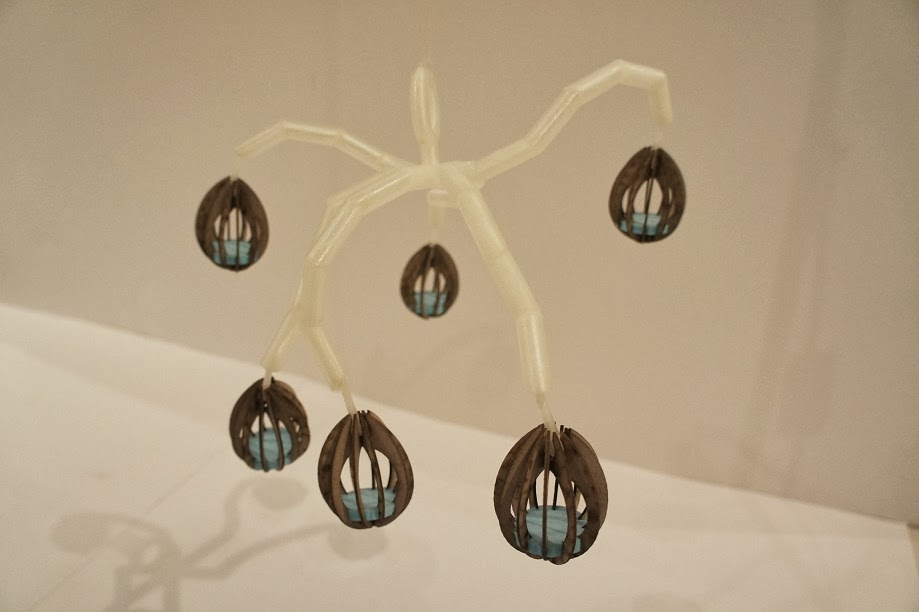
For the second draft I looked into another idea that my tutor suggested. I was trying to design a solid central tree structure to 3D print in one piece, and to suspend small little pods from. My tutor thought it would be a lot cooler to make the tree interactive and moveable, making it in individual parts that could lock together and swivel. I modelled the parts in SketchUp, making small pods and individual arms of the tree branches:


I 3D printed an individual arm... And then printed it again. And again. And again... 10 iterations required? How about 30:


I finally assembled the arms into the tree branch structure, all emanating from a core 3D printed hanger piece, and then assembled and attached the little pods. The first configuration:


I then rotated all the arms into a new configuration, which was pretty fun:


And another configuration... it wasn't supposed to be an octopus but hey, why not?


There's video footage of me reconfiguring the arms in the final production video later on.

With 3D printing, THE POSSIBILITIES ARE ENDLESS! THANKS MAKERWARE!

first draft design & assembly...


I attempted to materialize the early sketch in the first draft computer design. Three spherical zones are formed by the enclosure of external ribs and cages, intersected together into an ascending treehouse-like structure.


Here is the physical assembly, using laser cut boxboard ribs, blue foam platforms and 3D printed upper and lower cages.


My tutor responded well to my idea but we both decided to take it in a different direction. He thought the above design was an overly polished and perfect eco-retreat, like those splashed on all the magazines, and I agreed. I wanted to actually explore the idea of 'organic,' because organic means natural and real, and those can be extrapolated to mean unpolished and imperfect. What does organic mean?

An uglier version was necessary, a less perfected version... My tutor compared the perfectly round tomatoes found at Coles with the heirloom tomato type:


The Coles tomatoes are commercialised and regulated, genetically and chemically grown to look perfect and appealing. The heirloom tomato is much uglier but is specifically sought after for its taste, due to its natural and untreated growing. Which is more organic, more real? The attractive but synthetic and bland tomato, or the ugly but natural and tasty tomato?


invented brief and design idea...


 HANGING HOUSE


Based on Miranda Kerr's quote below, Hanging House will be an eco-retreat hanging from the tree canopy. It will be a lightly constructed skeletal-frame building, aiming for the often thrown-about title of 'organic architecture.'

In a very quick early sketch I hoped to capture a series of eco-pods interacting with each other and suspended from each other.


Wednesday, December 18, 2013

the client...


What is it that Miranda Kerr wants?


PROJECT ONE


3D printing examples


A collection of the semester's experimental and failed 3D prints:


early foam modeling and laser cutting


Some early experiments with blue foam modeling and hot wire cutting...


I used a scanner to capture the 2D face of this particular piece, then modeled it in Sketchup, ready to be sliced and laser cut:


Below are the laser cut pieces, the foam model and the assembled laser cut version replicating it: